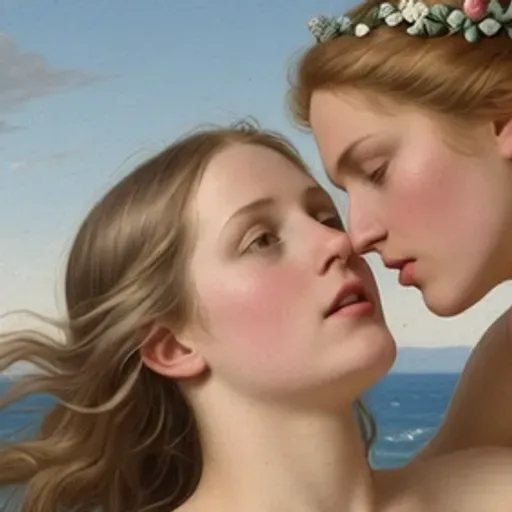
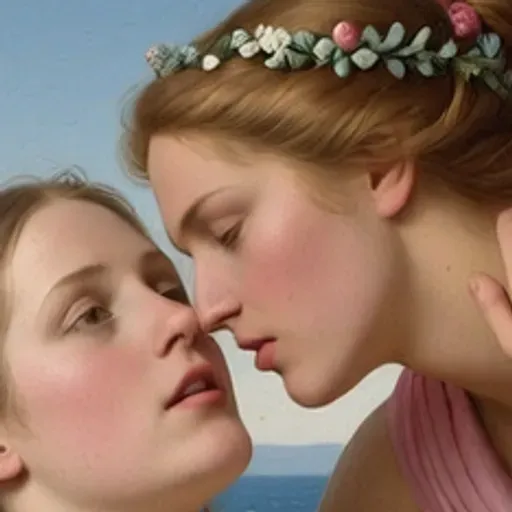
(masterpiece), (extremely detailed), (cinematic lighting), (realistic skin texture), (hyperrealistic), (photography), . Photographic reproduction of Sandro Botticelli's painting "The Birth of Venus".
Venus floats lightly on a shell across the rippling sea, in all her grace and unparalleled beauty, naked and distant like a splendid ancient statue. She is blown and warmed by the breath of Zephyr, the fertilizing wind, embracing a female figure who symbolizes the physicality of the act of love, moving Venus with the wind of passion. Perhaps the female figure is the nymph Chloris, or perhaps the wind Aura or Bora.
On the shore, one of the Hours, who presides over the changing seasons, particularly Spring, offers the goddess a magnificent pink cloak embroidered with flowers, (myrtle, primrose, and roses), to protect her. She represents Venus's chaste handmaiden and wears a silken dress richly decorated with flowers and garlands of roses and cornflowers, the flowers the goddess Flora found near the body of her beloved Cyanus.
The goddess's pose, with its balanced "contrapposto, " derives from the classical model of Venus pudica, (that is, covering her breasts and lower abdomen with her arms), and Anadyomene, (that is, "emerging" or rising from the sea foam), . The face appears to have been inspired by the features of Simonetta Vespucci, the woman of short life, (she died at just 23), and "unparalleled" beauty celebrated by Florentine artists and poets, while the background appears to have been inspired by the Gulf of Poets, where the painter is said to have met his muse.